


 Sign In
As with many aspects of life at the moment, the Dental Foundation Training (DFT) assessment and selection process has had to adapt to the ongoing COVID-19 pandemic. In previous years, the Situational Judgement Test (SJT) accounted for 50% of the total score that informed an applicant’s national ranking, with the face-to-face interviews contributing the remaining 50% of the score. This year, however, the rankings will be based on the SJT entirely. Although this may be welcome news for some, for others it makes the SJT even more daunting.
What is the SJT?
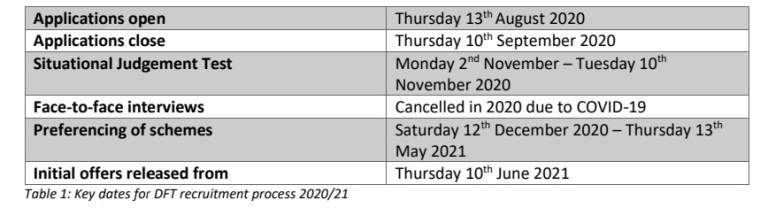
The SJT constitutes part of the application process for Dental Foundation Training in the UK. It is completed online in a pre-booked time slot at a Pearson Vue Test Centre. The available dates for this year’s DFT applications are shown in Table 1.
Students at UK universities will already be familiar with the term SJT, having done something similar as a component of the UK Clinical Aptitude Test (UKCAT) before applying for dental school. Although the form and content of the questions differs between the two types of SJT, the underlying idea is the same–namely, to assess non-academic and non-clinical knowledge. By presenting challenging scenarios that are likely to be encountered in the workplace, the SJT evaluates ethical understanding and professional attributes, which the GDC expects dental professionals to exhibit, such as integrity,team-working and coping under pressure.
In essence, there is no indisputably ‘correct’ answer as different individuals will justify their varying approaches to a scenario in their own nuanced ways. It is precisely this that makes the SJT so notoriously difficult to revise for. A different answer is not necessarily wrong, however, it does differ from the consensus of the group of experts who devised the questions. Hence, the aim when preparing for your SJT is to try and align your thinking with this body of professionals as much as possible, which is doable with practice and applying certain tips.
Format of the SJT
The test comprises 56 questions, of which 50 contribute to your final score. The remaining 6 are questions that are being piloted and have no bearing on your result. However, you will not be able to distinguish between two.
There are two types of SJT questions:
1. Ranking
- Presented with a scenario and 5 answer options
- Task: rank the 5 options from most to least appropriate
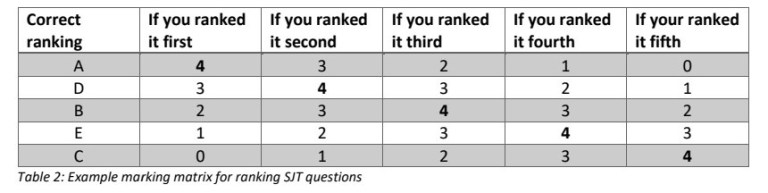
- Marking: maximum of 20 marks per question, with up to 4 marks available for each individual option i.e. 1 mark is lost for each place away from its correct ranking (Table 2)
2. Best of Three
- Presented with a scenario and 8 answer options
- Task: select the 3 most appropriate answers when considered together out of 8 given options
- Marking: maximum of 12 marks per question, with 4 marks for each correctly selected option and no marks for selecting an incorrect option
There is no negative marking so there is no excuse to not have a go!
Tips for the SJT
Applying certain strategies for each type of question can help to improve your score. For ranking-based questions:
- Consider all the options independently. They do not form a flowing story.
- Establish the best and worst answers first. They are usually the easiest to identify and also have the most potential for costing you marks if placed further from their correct position.The middle ranking answers are more forgiving if ranked incorrectly (Table 2).
- Theme the question. This can help to identify the best course of action e.g. in questions concerning confidentiality, preventing a breach will likely be the highest ranking answer.
When it comes to the ‘best of three’ questions, the most important thing to remember is that the correct answers are the three best options when considered together. Individually, another option may be better than one of the correct answers but it may not complement the other options. You are aiming to identify the most effective and comprehensive strategy to tackle the scenario given in the question. Therefore, do not select two almost identical options and also ensure that your chosen options do not contradict each other. A good combination often comprises options that put the patient’s interests first, involve/protect/help colleagues, and cover yourself (e.g. clinical notes or seeking indemnity advice).
Having mentioned colleagues, it is absolutely imperative that you recognise the role your team members can play and incorporate them within their scope of practice. Unless stated otherwise, you are answering as a DF1 so be aware of your limitations and do not try to handle every situation single-handedly. Some key figures who will crop up time and again throughout the SJT include:
- Educational supervisor (ES). This should be your first port of call for any clinical problems or concerns regarding professional development.
- Training Programme Director (TPD). This is the next step above your ES. The TPD can also be approached regarding concerns with clinical or professional development but usually only after the ES. On occasion, it may be appropriate to go directly to the TPD, for instance,where there is a breakdown in the relationship between the DF1 and ES or there are long-standing problems (e.g. repeated missed deadlines). They are also responsible for assessing the suitability of practices for DFT.
- Indemnity. The sole aim of this organisation is to protect you. However, they can only advise and not take any action. As a result, answer options revolving around indemnity organisations are usually passive. In ranking-based questions, this means it is unlikely to rank in the first or second position but also will not be the lowest ranked option, which is usually causing harm or ignoring a problem. In ‘best of three’questions, advice is often a good choice when complemented by two action options.
- Practice manager. This individual is responsible for staff management, human resources,holidays and ordering resources.
- Reception. Among the duties of the receptionist, one of the most important is booking inpatients appropriately. Remember, although they may not be registered with the GDC, they must still uphold certain values, such as patient confidentiality.
- Principal of the practice. This is not necessarily always the ES. The principal is responsible for practice equipment and resources.
Of course, this list is not exhaustive and there are several others to consider, such as the dental nurse, technician and DF1 colleagues to name but a few. Finally, there are several tips that can be applied generally to the test as a whole:
- Practise, practise, practise. Familiarise yourself with the format and you will get better. It will also help to identify gaps in your knowledge that you could do with reading up on in more detail.
- Time yourself. Practise under timed conditions to reflect the real SJT.
- Do your homework.Read up on important guidelines, regulations and relevant legislation and be aware of the various dental organisations (regulatory bodies, indemnity organisations, professional unions etc.) that exist and what they do in a broad sense.
- Do not make assumptions. Use only the information given in the scenario to make your decisions.
- Do no harm. The worst option in any question will involve causing harm to a patient.Therefore, even doing nothing can sometimes be a more preferable answer despite its obvious drawbacks.

